Embodied Robot Innovation Design Kit (40-in-1) Ubot MR40
Build 40 typical embodied robot configurations from scratch, covering chassis, robotic arms, and composite robots. Supports graphical programming plus C++ (Arduino) and Python development, with progressive curriculum resources for introductory robotics education, innovation projects, and competition training.
Applicable Audience/Scenarios
K12, vocational/college year 1, undergraduate freshmen
Highlights
- Modular design for building 40 classic robot configurations
- Compatible with graphical programming and C++/Python development
- Supports beginner robotics education, innovation projects, and competition training
Product Features
Programming Methods
Ubot MR40 requires no prior programming experience. Learners can start with block-based programming to build core control logic through drag-and-drop interactions, and can later progress to more advanced development with C++ and Python.
Assembly Method
We've refined assembly difficulty down to every hole design, including spacing, size, and whether it's a threaded hole. While ensuring structural strength, we minimize unnecessary nuts to reduce assembly difficulty, making it easier for learners to get started and focus their learning energy on overall design.
Lab Scenarios
The sample adopts modular design. Robot chassis configurations are designed based on differential wheel modules, caster wheel modules, universal wheel modules, steering wheel modules, omnidirectional mecanum wheel modules, gripper modules, and swing modules to create: three-wheel dual-drive differential chassis, three-wheel dual-drive front-wheel steering chassis, four-wheel dual-drive differential chassis, four-wheel four-drive differential chassis, and four-wheel four-drive mecanum omnidirectional chassis. Robot arm configurations are designed based on swing modules, turntable modules, and gripper modules to create: gimbal, 3-DOF robotic arm, and 4-DOF robotic arm configurations.
Robot Modules
Robot Chassis
Robotic Arm Configurations
Composite Robots
Configuration
Sensor Configuration
Integrates a posture sensor, a 4-channel line-tracking sensor, two ultrasonic sensors, a voice-recognition sensor, a speaker module, and a PS controller. It supports automatic obstacle avoidance, maze navigation, autonomous reverse parking, line following, voice interaction, and remote-control functions. Students can also use Ubot MR40 for engaging project work such as simulated lunar exploration tasks.
- 6-axis gyroscope sensor
- 4-line path tracking sensor
- Ultrasonic sensor
- Voice recognition sensor
- Speaker module
- Remote controller
Controller Configuration
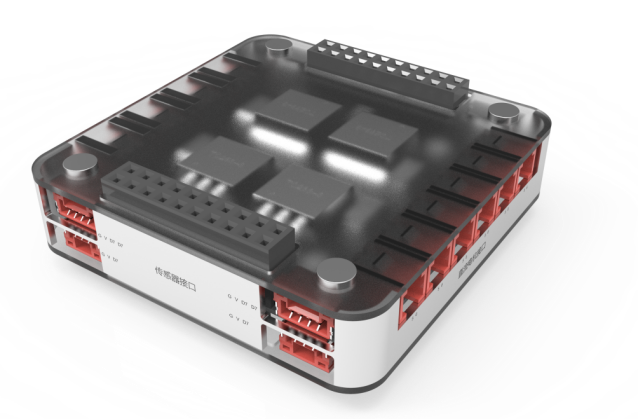
The controller supports common programming language inputs, including block-based, C++, Python, and other programming languages. It provides rich interfaces, including 6 DC motor ports, 8 servo ports, 4 ultrasonic ports, 4 line-tracking sensor ports, 4 expansion I/O sensor ports, USB serial port, etc. The controller adopts stackable design with reserved expansion dock connectors, making it easy for users to connect other electronic hardware to the controller.
Software Configuration
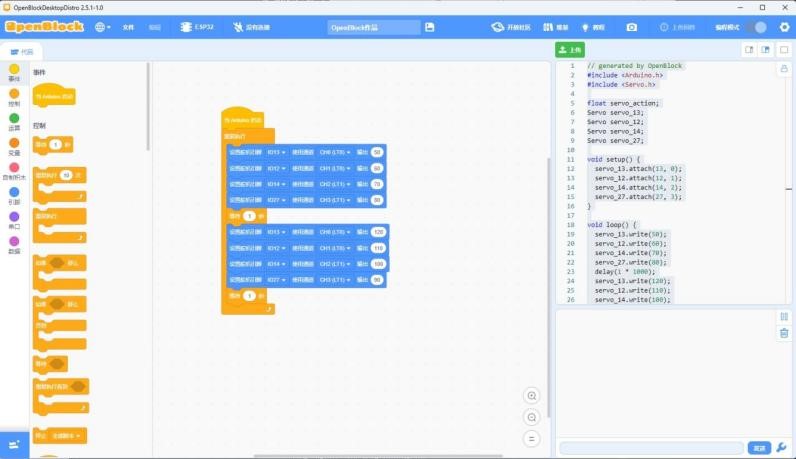
The software integrates OpenBlock programming environment, supporting both block-based programming and C++/Python code programming. It can be used for software programming as well as hardware device programming, supporting hardware code generation and compilation download functions, and also supporting real-time operation mode through real-time communication with hardware devices.
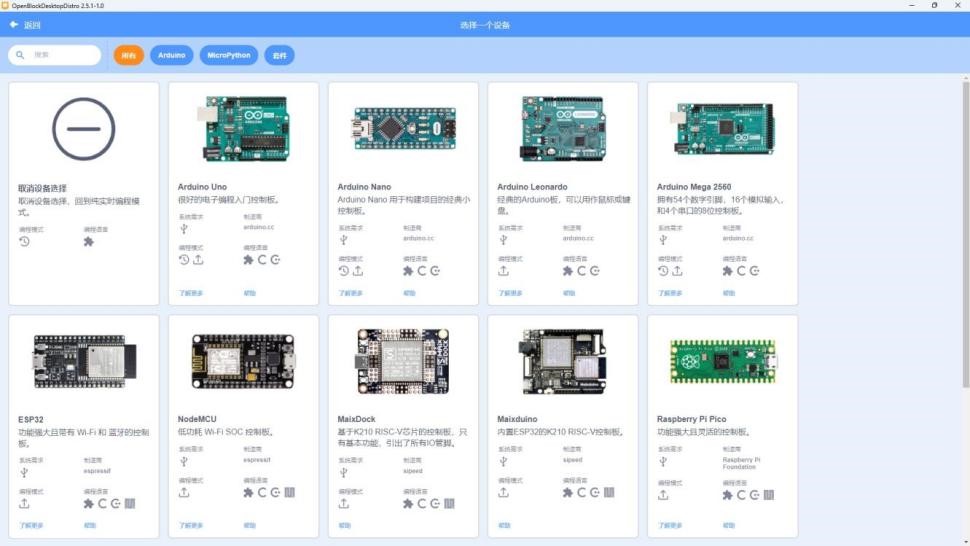
OpenBlock has a complete hardware ecosystem, supporting popular maker hardware platforms on the market, including Arduino, MicroPython, and ESP32, allowing users to expand freely.
Documentation
Get more technical documentation, tutorials, and FAQs about this product.